 Tout Corps d’État
24 octobre 2026
ONCEIM
Biennale Musica 2026
Venise
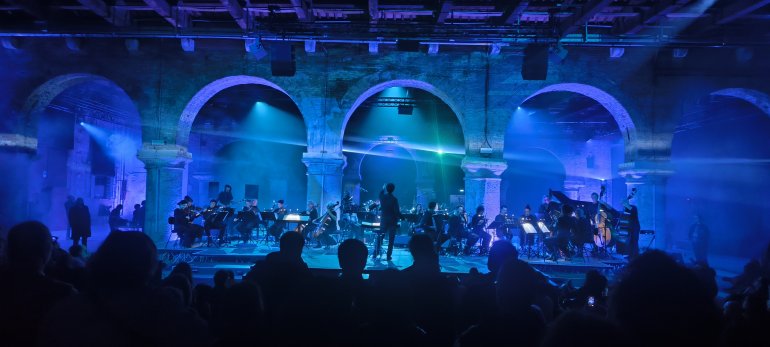
ONCEIM - Ellen Arkbro : For orchestra, 2022 (30’, Italian premiere)
ONCEIM - Caterina Barbieri : Non puoi contare l’infinito, 2026 (35’ ca.) for large ensemble, four voices, electronics
Commissioned by : Philharmonie de Paris
Electronics : Caterina Barbieri ONCEIM conducted by : Frédéric Blondy
ONCEIM Musicians : Martine Altenburger, Anaïs Moreau (cellos), Sébastien Beliah, Benjamin Duboc, Frédéric Marty (double basses), Amaryllis Billet, Clara Levy (violins), Camille Coello, Claire Merlet, Marie Schwab (violas), Giani Caserotto, Jean-Sébastien Mariage (guitars), Vincent Gailly (accordeon), Alvise Sinivia (piano), Juliette Adam, Brendan Champeaux, Julien Pontvianne (clarinets), Bertrand Denzler, Benjamin Dousteyssier, Carmen Lefrancois, Sebastian Sarasa (saxophones), Fabrice Charles, Alexis Persigan (trombones), Diemo Schwarz (electronics), Julien Loutelier (drums), Rémi Durupt (percussion), Léa Trommenschlager, Michiko Takahashi, Juliette Meyer (voices), Brice Pichard, Christian Pruvost (trumpets), Victor Auffray, Abel Nantois (euphonium)
Onceim, founded in Paris in 2012 by composer and conductor Frédéric Blondy and dedicated to contemporary experimental and electroacoustic music, appears at the Biennale Musica 2026 with two Italian premieres. The programme opens with Ellen Arkbro’s For Orchestra, a composition rooted in her exploration of intervallic harmony in just intonation. Working with long-duration harmonic structures, Arkbro creates an orchestral sound environment in which listening becomes an active process, inviting gradual immersion in the evolving qualities of harmonic sound.
The second part presents Artistic Director Caterina Barbieri’s Non puoi contare l’infinito (2026), commissioned by the Philharmonie de Paris for orchestra, four voices and electronics. Here, Barbieri extends into the orchestral domain the generative and semi-aleatory techniques developed through her work with electronic music and analogue synthesisers. At its core lies a harmonic matrix originally programmed on her analogue ER-101 sequencer, whose combinatorial possibilities are explored through the coexistence of notation and improvisation, gesture and texture, and the shifting relationships between deterministic and open processes. Structured in two acts, the composition explores themes of birth and separation, tracing the passage from unity to difference, from the infinite to the finite.
Voir en ligne : Biennale Musica 2026 Venise